Author: Kris Cole
Every fall, nonprofit teams brace for Giving Tuesday like it’s the Super Bowl of their fundraising calendar. Emails get drafted, boards get anxious, social calendars get color-coded. And then the day comes and goes, the number lands somewhere respectable-but-not-huge (or even disappointing), and everyone quietly wonders if they did something wrong.
You didn’t. Giving Tuesday was never built to be your biggest fundraising day — and treating it that way is where most organizations set themselves up to feel disappointed by a genuinely useful tool.
Here’s how to think about it instead, and what the data actually says about each piece.
Manage your Expectations
Giving Tuesday is loud. In 2025, it drove $4.0 billion in giving across the U.S.1 — a real number, but one spread across tens of millions of donors and, realistically, hundreds of thousands of organizations all asking at once. That’s the defining feature of the day: everyone is shouting into the same 24 hours.
The data backs up something worth sitting with: Giving Tuesday and year-end giving are not the same event. In 2024, just 2.4% of all donors nationwide gave specifically on Giving Tuesday2 — meaning the overwhelming majority of your year-end supporters are giving on their own timeline, not on the day the internet decided was giving day. December as a whole typically accounts for 17–20% of a nonprofit’s annual revenue;3 Giving Tuesday is one day inside that much bigger window, not a stand-in for it.
So: you will raise money. Just don’t build your annual plan as if Giving Tuesday is where the bulk of it lives. Most of what comes in that day functions less like a major gift and more like an impulse buy — someone scrolling, seeing your case for support land at the right moment, and reacting. That’s not a knock on the gift. It’s useful information about what your job actually is that day: not to close a major campaign, but to convert a reactive first touch into a believer who sticks around. The data suggests that conversion is very real when you do it right — Giving Tuesday donors make a repeat gift at a 65% rate, compared to 52% for donors overall, a gap that’s held steady for five years running.4
Give People One Specific Thing to Rally Behind
Vague asks get vague results. Specific asks get remembered.
Years ago, while I was working at a wildlife conservation center, our radiograph (X-ray) machine broke — two weeks before Giving Tuesday. Instead of running our usual general appeal, we pivoted the entire campaign around replacing it: $17,000, a hard number, with a simple explanation of why it mattered. Our patients couldn’t tell us where it hurt. The X-ray machine was how we found out. That was the whole pitch.
We doubled our fundraising goal that year.
It won’t always be a broken piece of equipment, and this approach won’t produce a doubled goal every time — but the underlying lesson holds regardless of the specifics: give people a concrete, understandable need with a real number attached, and they will rally around it in a way they never will around “help us continue our important work.” Giving Tuesday rewards specificity because it’s a scroll-and-decide moment. Make the decision easy.
Don’t Overextend Your Bandwidth On It
Because Giving Tuesday is one day inside a much bigger season — remember, December alone is 17–20% of your annual revenue — it shouldn’t consume disproportionate energy from your team. The real prize is your full end-of-year giving push, and by the time Giving Tuesday arrives, that campaign should already be well underway, not waiting in the wings.
Use Giving Tuesday as a kickoff moment or an accelerant for the case you’re already making. Weave it into your existing year-end strategy rather than treating it as a separate, all-hands campaign that competes with everything else on your plate in November and December. Don’t skip it — but don’t burn your team out protecting a single day’s number at the expense of the six weeks around it.
Treat It Like What It Is: A Social Media Day
Giving Tuesday is, at its core, a social fundraising event. It generates an outsized share of that day’s online conversation — posts tagged to the day have produced more than 20 billion social media impressions in a single campaign.5That’s where the day lives and where it earns its keep — reaching people, especially younger donors, who respond to a moment of collective, visible generosity more than a traditional direct-mail appeal.
That means your energy and budget on Giving Tuesday itself belong almost entirely on social. Skip the print piece, skip the elaborate microsite build — put the effort into a tight, well-paced social push instead.
One more move worth making: look for organizations in your area already amplifying Giving Tuesday messaging collectively. In Charlotte, SHARE Charlotte runs #GivingTuesdayCLT, pooling hundreds of area nonprofits, local businesses, and individual donors into one coordinated, community-wide campaign — it’s generated more than $36 million for Mecklenburg County nonprofits and activated over 27,000 new donors along the way.6 You don’t have to build your Giving Tuesday reach alone. Find your region’s version of that collaboration, and plug in.
Build Real Structure Around the Day
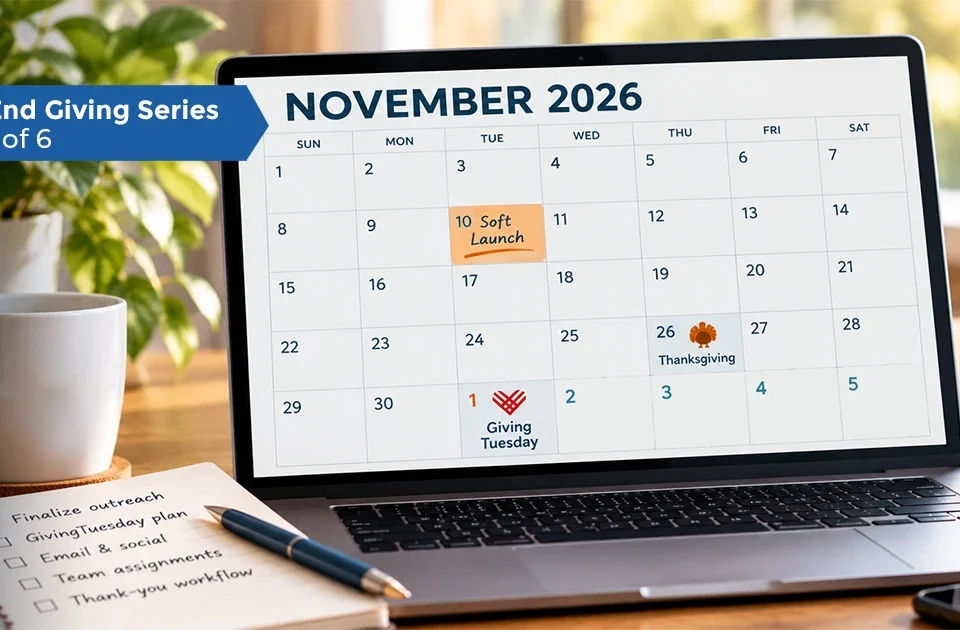
A good Giving Tuesday campaign isn’t just a single post on the day itself. Build it like a short campaign:
- Leading up to the day: a short email sequence warming your list up, introducing the specific ask, and building anticipation.
- On the day itself: multiple social posts, spaced through the day rather than front-loaded — morning momentum, midday reminder, evening final push.
- After the day: a genuine thank-you, regardless of how the number landed, that starts the real work of turning a one-time gift into an ongoing relationship.
The Bottom Line
Don’t knock yourself out over Giving Tuesday. It was never designed to carry your year. But don’t skip it either — it’s a real, useful piece of a bigger end-of-year strategy, a chance to reach new people, tell a specific story, and start relationships you’ll spend the rest of the year (and beyond) developing. Treat it as one well-built beat in a longer campaign, not the whole song, and it’ll do exactly what it’s supposed to do.
Need help making plans for this year’s Giving Tuesday — and beyond? Reach out and let’s start a conversation.
- GivingTuesday 2025 Results ↩︎
- Insights from the Blackbaud Institute x GivingTuesday Report ↩︎
- 360 MatchPro: Top Nonprofit Fundraising Statistics to Know: Updated 2026 ↩︎
- Special Report: GivingTuesday x Blackbaud Institute ↩︎
- GivingTuesday: A Global Movement in its Thirteenth Year ↩︎
- Share Charlotte: Community-Wide Giving Campaigns ↩︎