Author: Kris Cole
Part 1 of a six-part series on planning a successful year-end giving campaign.
If you’re a development professional, you already know the feeling: it’s early November, leadership is asking when the year-end appeal will launch, and you’re still building the campaign you’re supposed to be sending. Every year it happens, and every year it’s harder than it needs to be.
Here’s the thing — the organizations that have their best Decembers aren’t the ones with the biggest lists or the flashiest campaigns. They’re the ones who started planning in late summer or early fall, while there was still room to think clearly.
That’s what this series is for. Over the next five months, we’re going to walk through a complete roadmap for a successful year-end campaign — one month at a time, matched to what you should actually be doing right now. Consider this Part 1 your kickoff: why the planning window matters, what the whole year-end arc looks like, and a free toolkit to get you started today.
Why December Carries So Much Weight
If you’ve ever wondered whether all the fuss over year-end giving is warranted, the numbers answer that pretty clearly. According to M+R Benchmarks, roughly 40% of annual online revenue is raised in December alone — though that varies by sector, from as low as 23% to as high as 52% depending on your cause area.1 Even more strikingly, December 31 by itself accounts for about 5% of annual giving — and that single day’s giving grew 11% year-over-year from 2023 to 2024.1
Then there’s GivingTuesday, which has become the unofficial starting gun for the entire season. In 2025, GivingTuesday raised $4.0 billion in the U.S. alone, up 13% from the year before, with 19.1 million people making a financial gift.2 Since it launched in 2012, GivingTuesday has generated a cumulative $22.5 billion for causes around the world.2
Put simply: a huge share of what your organization will raise this fiscal year is going to happen in a six-to-eight week window between late November and December 31. That’s not a reason to panic — it’s a reason to plan early, so that window works in your favor instead of catching you flat-footed.
The Roadmap: Your Year-End Campaign Timeline
A successful year-end campaign doesn’t start on GivingTuesday — it starts now, in the fall, and runs all the way through donor stewardship in the new year. Here’s the full arc we’ll be walking through together, post by post:
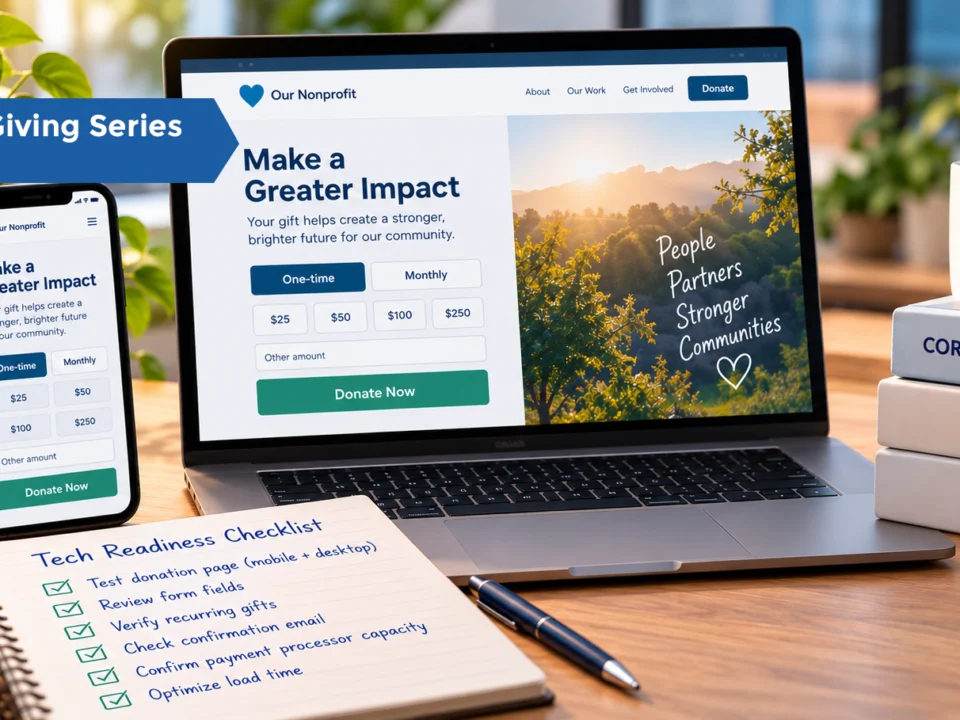
September & October — Planning & Prep. This is the unglamorous but essential work: setting clear financial and impact goals, segmenting your donor list, reviewing what worked (and didn’t) last year, making sure your website’s donation page actually works under load, and locking down any corporate matching gifts or challenge grants that can multiply December’s impact. We’ll cover all of it in next month’s post.
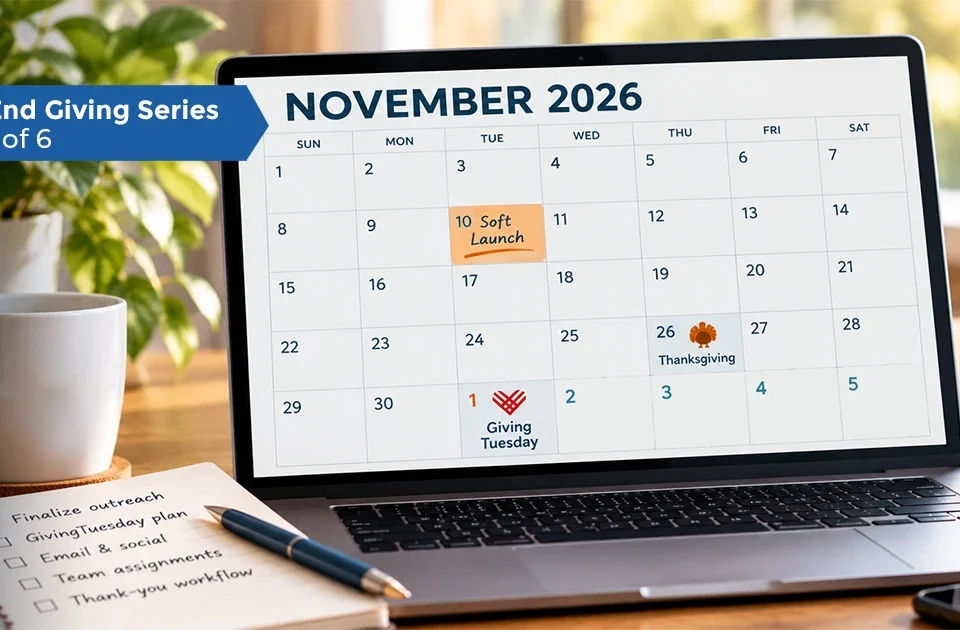
November — Soft Launch & GivingTuesday. Mid-November is for a quiet, warm touch — a pre-Thanksgiving thank-you or soft appeal to your major and recurring donors, before anyone else hears the campaign ask. Then, the Tuesday after Thanksgiving, you launch publicly with GivingTuesday as your kickoff moment — followed immediately by automated receipts and thank-yous so no GivingTuesday donor waits to hear back from you.
December — Momentum & the Final Push. By mid-December (think December 15), it’s time to build real urgency: progress bars, impact stories, countdown reminders. Then comes the final stretch — December 29 through 31 — where a disproportionate share of annual revenue lands, driven by both tax deadlines and holiday-season generosity. Yes, that includes a midnight email on December 30 for the last-minute gifts. Better yet, send two emails between December 30-31 to reach your donors when the season is its most hectic.
January & February — Stewardship. The campaign isn’t over when the calendar flips. Prompt tax receipts, personalized thank-yous, and a report back to donors on what their generosity actually accomplished all belong here — plus a look back at your own metrics and team performance. One idea we’ll dig into: proactively sending major and recurring donors a consolidated “Statement of Support” for the year in mid-to-late January. It’s both a practical convenience for their taxes and one more meaningful touchpoint.
The Cost of Waiting
It’s worth naming what actually happens when a year-end campaign gets built on the fly. Goals get set based on a gut feeling instead of last year’s data, because there’s no time to pull the real numbers. Segmentation doesn’t happen at all, so major donors and $25 first-time givers get the exact same email. The donation page hasn’t been tested since last spring, so nobody finds out it’s broken on mobile until a donor emails to complain on November 28. And corporate matching gift conversations — which often take six to eight weeks to close — never get anywhere because there wasn’t runway to start them in October.
None of that is a failure of effort. Development teams working under a late-fall scramble are usually working harder, not less carefully, than teams who started early. The difference isn’t effort — it’s sequencing. A little bit of structure in August and September buys back the time and calm you’ll need in December, when you actually want to be focused on donors and stewardship instead of logistics.
What to Do This Month, While November Feels Far Away
You don’t need to build the whole campaign today. But a few things are worth starting now, precisely because they’re easy to put off
Block your calendar. Pencil in internal deadlines for each phase above — goal-setting, segmentation, website testing, the GivingTuesday launch, the December push. If it’s not on a calendar, November will eat it.
Pull last year’s numbers. You’ll want them close at hand next month when we talk about goal-setting — total raised, donor count, average gift size, and where the surprises were.
Start the corporate matching gift conversation. These take longer to secure than people expect. If there’s a company relationship worth exploring for a matching or challenge gift, the outreach should start now, not in November.
Your Starting Point: The Year-End Giving Planning Toolkit
To help you actually act on all of this, we put together a free downloadable Year-End Giving Planning Toolkit — a practical starting point you can use today, before next month’s deep dive into planning and prep. Inside, you’ll find:
- A full campaign calendar, mapped from August through February, with every key date from this series pre-loaded
- A goal-setting worksheet to define your revenue and donor targets
- A donor segmentation checklist
- A website & technology readiness checklist
- A simple corporate matching gift tracker
Download the toolkit, block an hour on your calendar this week, and give your team the gift of a calmer, more successful December. Next month, we’ll build on that foundation together.
Next up in this series: September & October — Planning and Prep, where we get specific on goal-setting, segmentation, and getting your systems ready for the season ahead.
- 12-Year-End Giving Statistics Every Fundraiser Should Know for 2025 — Neon One, citing M+R Benchmarks data ↩︎
- Generosity Sweeps the Globe: Participation and Donations Rise on Another Record-Breaking Giving Tuesday — GivingTuesday.org 2025 Results ↩︎